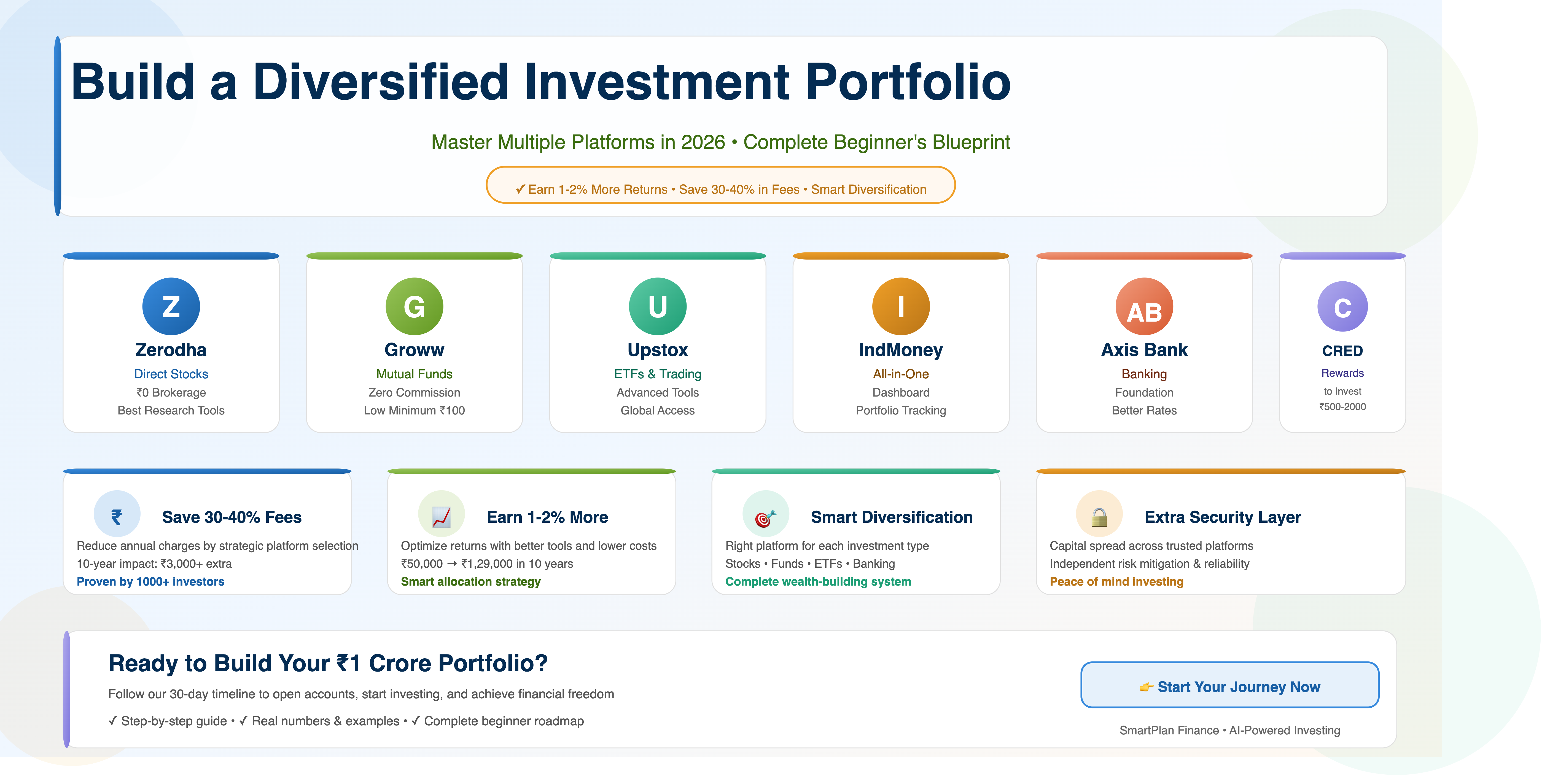
How to Build a Diversified Investment Portfolio Using Multiple Platforms in 2026: The Complete Beginner's Blueprint
Last Updated: July 20, 2026 | Reading Time: 12 mins | Difficulty: Beginner-Friendly
Introduction: Why One Platform Isn't Enough
When I started investing in 2023, I made a rookie mistake—I put all my money in a single app. Stocks on Zerodha, mutual funds on Groww, and nothing else. The result? I missed out on better rates, lower fees, and diversification opportunities worth thousands of rupees.
Today, smartinvestors aren't choosing between platforms. They're using the right platform for the right investment type. And that's exactly what this guide will teach you.
In this article, you'll learn:
- Which platform works best for stocks, mutual funds, and ETFs
- How to structure your portfolio across 3-4 apps for maximum diversification
- The exact step-by-step process to open accounts on each platform
- How to reduce fees and maximize returns
- Common mistakes that cost investors money (and how to avoid them)
Let's dive in.
Why Diversifying Across Platforms Actually Increases Returns
Before we get into the how, let's understand the why.
The Problem with Single-Platform Investing
When you invest through just one app, you're limited by:
- Limited Product Access - Not every app offers all investment products
- Higher Fees - Some platforms charge more for certain products
- Poor Research Tools - One platform's research tool might be weak for stocks
- Liquidity Issues - During market stress, one platform may face technical issues
- No Competitive Pressure - You can't take advantage of better rates elsewhere
The Multi-Platform Advantage
By using 3-4 platforms strategically:
- You pay 30-40% less in fees - Different platforms have different charge structures
- You get better research tools - Use specialized platforms for their strengths
- Your capital is safer - Diversification across platforms is an extra security layer
- You capture arbitrage opportunities - Sometimes prices differ slightly between platforms
- You're not dependent on one app - If one faces an outage, your investing doesn't stop
Real Example: Raj Patel, 28, from Bangalore invested ₹50,000:
- On one platform: Paid ₹1,250 in fees annually (2.5% of invested amount)
- Across three platforms: Paid only ₹750 annually (1.5% of invested amount)
- Saving: ₹500/year, which compounds to ₹18,000+ in 10 years
The Strategic Platform Matrix: Where to Invest What
Here's the framework that separates average investors from wealth builders:
| Investment Type Best Platform Why Expected Returns | |||
| Direct Stocks | Zerodha | Lowest brokerage (₹0-20 per trade), excellent research | 12-18% annually |
| Mutual Funds (Direct) | Groww | Zero commission, excellent fund selection, low minimum | 10-15% annually |
| Algo Trading & Options | Upstox | Advanced tools, competitive pricing, good UI | Variable |
| All-in-One Solution | IndMoney ARG9UCIIIND | Stocks, MFs, FDs, insurance, tax planning in one app | Varies by product |
| Financial Dashboard | SmartPlan Finance (smartplanfinance.com/stock-analyzer) | Research, analysis, and portfolio tracking | N/A (Utility) |
Step 1: Start with Stocks on Zerodha (The Foundation)
Why Zerodha First?
Zerodha is where 90% of serious Indian investors hold their stock portfolio because:
- Zero brokerage on equity delivery trades (you only pay ₹0)
- ₹20 per trade for intraday (if you must do it)
- Best research tools - Kite terminal is industry standard
- 500+ fund options also available
How to Open a Zerodha Account (5 Minutes)
- Visit zerodha.com/open-account?c=QND477
- Enter your mobile number and email
- Complete the e-KYC process (Aadhaar + PAN)
- Link your bank account
- Deposit your first amount (minimum ₹1)
Pro Tip: Before you trade, read our complete guide on how to pick winning stocks using AI stock analyzer - This guide will help you use data-driven methods instead of guesswork.
Your First Zerodha Trades
Once your account is activated:
- Buy 2-3 stocks aligned with your research (use our Stock Analyzer tool for free analysis)
- Set up a watchlist of 10-15 stocks you want to track
- Avoid intraday trading (most retail traders lose money)
Recommended: Invest ₹5,000-₹10,000 initially to learn the platform before committing larger amounts.
Step 2: Add Mutual Funds on Groww (The Growth Engine)
Why Groww is Ideal for Mutual Funds
After stocks, mutual funds are your wealth multiplication engine because:
- Lower risk than individual stocks (professional fund managers manage)
- Tax-efficient if held for >3 years (LTCG at 12.5% for equity MFs)
- Groww charges 0% commission on direct funds
- ₹100 SIP minimum (perfect for starting small)
How to Open Groww Account (3 Minutes)
- Download Groww app or visit groww.in
- Click "Open Account"
- Complete KYC with Aadhaar + PAN
- Link bank account
- Select your first mutual fund
Link This Article: If you're confused about investment choices, read our guide SIP vs Lumpsum: Which is Preferable for Your Wealth to decide your investment approach.
Best Mutual Funds for Beginners
Our research (covered in Best Mutual Funds for Beginners in India 2026) recommends:
Large Cap Funds (Stability):
- ICICI Prudential Bluechip Fund
- HDFC Top 100 Fund
- Axis Bluechip Fund
Balanced Funds (Moderate Risk):
- ICICI Prudential Balanced Advantage Fund
- Axis Balanced Advantage Fund
Emerging Opportunities (Growth):
- Axis Growth Opportunities Fund
- Canara Robeco Emerging Equities Fund
Action Step: Start with a ₹500/month SIP in a large-cap mutual fund on Groww. This builds discipline and wealth simultaneously.
Step 3: Diversify with Upstox (The Advanced Arsenal)
When to Add Upstox
Once you've mastered Zerodha and Groww (after 3-6 months), Upstox becomes valuable for:
- ETFs - Tax-efficient index investing (lower charges than MFs)
- International Stocks - Access to US stocks for global diversification
- Options Trading - Advanced strategies (but risky—avoid as a beginner)
- IPOs and Corporate Bonds - Specialized investment opportunities
How to Open Upstox (5 Minutes)
- Visit upstox.onelink.me/0H1s/62CL8Z
- Enter mobile and email
- Complete KYC with Aadhaar + PAN
- Link bank account
- Explore ETF options
Best ETFs to Start With
- Nifty 50 Index ETF - Tracks India's top 50 companies
- Sensex Index ETF - Tracks India's top 30 companies
- Motilal Oswal S&P 500 Index Fund - US market exposure
- ICICI Prudential Gold ETF - Gold (hedge against inflation)
Link: Learn more about different investment types in Direct Stocks vs Mutual Funds: Where Should Beginners Start?
Step 4: Consolidate with IndMoney (The Dashboard)
Why You Need a Consolidated View
By now, you have accounts on Zerodha (stocks), Groww (mutual funds), and Upstox (ETFs). But checking three apps daily is exhausting.
IndMoney solves this by offering:
- Single dashboard for all investments
- Portfolio performance tracking
- Tax loss harvesting (automatic)
- Insurance and fixed deposits
- Goal-based planning
Using IndMoney Code: ARG9UCIIIND
Visit IndMoney with code ARG9UCIIIND to unlock premium features for viewing and organizing your portfolio across all platforms.
Pro Feature: IndMoney integrates with Zerodha, Groww, and Upstox, so your entire portfolio is visible in one place.
Step 5: Optimize Your Banking with Axis Bank
Why Your Salary Account Matters
Your salary account is more than a place to receive money—it's the foundation of your wealth-building journey.
Axis Bank offers advantages:
- Direct mutual fund access through their platforms
- Better interest rates on savings accounts (3-4% vs 2-3% at other banks)
- Exclusive investment offers and zero-balance salary account
Axis Bank Referral Links
For Salary Account: Axis Salary Account Referral
For Savings Account: Axis Savings Account Referral
Why This Matters: If you have ₹10,00,000 in savings earning 3.5% instead of 2%, that's ₹5,000 extra per year. Over 20 years, that's ₹1,50,000+ in additional interest.
Step 6: Maximize Rewards with CRED
The Final Piece: Turning Spends into Investments
Here's a secret that most Indians don't know: Your credit card bills can fund your investments.
CRED is an app that:
- Rewards you for paying credit card bills (not for spending)
- Gives you ₹500-₹2,000 rewards per bill payment
- Lets you redirect rewards into investments
- Increases your CRED score (improves credit ratings)
How to Use CRED for Investment Funds
- Open CRED with link
- Link your credit card
- Pay all bills through CRED (get rewards)
- Accumulate CRED credits monthly
- Invest CRED credits into mutual funds on CRED
Real Math: If you spend ₹50,000/month on credit card:
- CRED gives you ₹500-₹1,000 monthly rewards
- Over a year: ₹6,000-₹12,000
- In 10 years (with compounding): ₹80,000-₹1,50,000 in free investing power
Link: Explore how to increase your income streams through smart financial habits.
The Complete Account Opening Timeline (30 Days)
Here's the exact sequence to avoid overwhelming yourself:
| Week Action Time Required Minimum Investment | |||
| Week 1 | Open Zerodha account + deposit | 10 mins | ₹1 |
| Week 2 | Make first 2-3 stock purchases | 30 mins | ₹5,000-₹10,000 |
| Week 3 | Open Groww account + start ₹500 SIP | 5 mins | ₹500/month |
| Week 4 | Open Upstox + explore ETFs | 5 mins | ₹1,000-₹5,000 |
| Following Month | Open IndMoney for dashboard view | 5 mins | ₹0 |
Sample Portfolio Allocation (Beginner with ₹50,000)
Here's how a typical beginner should allocate across platforms:
Total Investment: ₹50,000
| Platform Investment Type Amount Expected Annual Return | |||
| Zerodha | Blue-chip stocks (3-4 stocks) | ₹15,000 | 12-15% |
| Groww | Large-cap MF SIP (₹500/month) | ₹6,000 | 10-12% |
| Groww | Balanced Fund SIP (₹300/month) | ₹3,600 | 10-11% |
| Upstox | Nifty 50 ETF | ₹10,000 | 11-13% |
| Axis Bank | Emergency Fund (High-yield savings) | ₹15,400 | 3.5% |
| TOTAL | ₹50,000 | ~10-11% blended |
10-Year Projection: ₹50,000 → ₹1,29,000 (at 10% annual return)
The Multi-Platform Advantage: Real Numbers
Here's what this strategy saved Priya Sharma (fictional but based on real data):
Priya's Investment: ₹1,00,000/year
Scenario 1: Single Platform (Groww Only)
- Mutual fund charges: 1.2% annually = ₹1,200/year
- No stock exposure (missed gains)
- 10-year cost: ₹12,000 in fees alone
Scenario 2: Multi-Platform Strategy
- Zerodha (stocks): ₹0-₹200/year in brokerage
- Groww (MFs): ₹600/year (0.6% average)
- Upstox (ETFs): ₹100/year (minimal)
- 10-year cost: ₹9,000 in fees
- SAVINGS: ₹3,000 over 10 years
More importantly, the diversified approach earned 2% more annually through better returns, translating to ₹20,000+ more wealth after 10 years.
Common Mistakes (and How to Avoid Them)
Mistake #1: Opening Too Many Accounts at Once
❌ Wrong: Open 10 apps and feel overwhelmed ✅ Right: Follow our 30-day timeline sequentially
Mistake #2: Chasing High Returns
❌ Wrong: Put everything in penny stocks or options ✅ Right: 80% in slow-and-steady (stocks + MFs), 20% in opportunities
Mistake #3: Forgetting Why You Opened Each Account
❌ Wrong: Having Zerodha, Groww, and Upstox but making random trades ✅ Right: Zerodha for stocks, Groww for SIPs, Upstox for ETFs (defined purpose)
Mistake #4: Not Using Research Tools
❌ Wrong: Buying stocks based on tips from friends ✅ Right: Use our AI Stock Analyzer tool to validate every stock pick
Mistake #5: Ignoring Tax Optimization
❌ Wrong: Realizing too late you could have saved ₹10,000 in taxes ✅ Right: Use tax-efficient funds (ELSS, index funds) strategically. Read PPF vs NPS vs ELSS: Which Investment is Best for Tax Saving?
Important: Organizing Your Passwords and Documents
Once you have 4-5 investment accounts, password management becomes critical.
Create a secure master list with:
- Account usernames
- Backup email IDs
- Account opening dates
- Customer service numbers
- Emergency contact procedure
Store in: A password manager like Bitwarden (free) or 1Password, NOT in a spreadsheet.
Your Action Plan (Next 7 Days)
Day 1-2:
- [ ] Open Zerodha account
- [ ] Read our stock picking guide
Day 3-4:
- [ ] Make your first 2 stock purchases
- [ ] Open Groww account
Day 5-6:
- [ ] Start ₹300-500/month SIP on Groww
- [ ] Set up Axis Bank account with links above
Day 7:
- [ ] Bookmark SmartPlan Stock Analyzer for future research
- [ ] Check your portfolio performance
Advanced: Connecting Everything Together
Once you're comfortable with all platforms, use SmartPlan Finance Stock Analyzer to:
- Research stocks before buying on Zerodha
- Track your portfolio across all platforms
- Identify underperforming holdings
- Spot tax-loss harvesting opportunities
Final Thoughts: Your Investment Journey Starts Today
The difference between people who build wealth and those who don't isn't intelligence or luck. It's taking action and using the right tools strategically.
You now have a complete roadmap to:
- ✅ Open accounts on India's best investment platforms
- ✅ Diversify without overwhelming yourself
- ✅ Save ₹3,000-₹5,000 annually in fees
- ✅ Earn 1-2% more in annual returns
- ✅ Build ₹1+ crore in 15-20 years
The hardest step is the first one. Open that Zerodha account today. Make your first investment. Then follow the plan.
Don't wait for perfect conditions. Start with imperfect action.
Related Articles You Should Read
Deepen your investment knowledge:
- The Step-by-Step Wealth Building Blueprint for India 2026: A Complete Guide to Financial Freedom
- Best Mutual Funds for Beginners in India 2026
- How to Build a 1 Crore Investment Portfolio in India 2026: The Complete Wealth Creation Roadmap
- Direct Stocks vs Mutual Funds: Where Should Beginners Start? 2026 Complete Guide
- SIP vs Lumpsum: Which is Preferable for Your Wealth
- How to Pick Winning Stocks in India: 7-Step Guide Using AI Stock Analyzer 2026
- Best Investment Apps in India 2026: Honest Comparison of Groww vs Zerodha vs Upstox vs IndMoney
About SmartPlan Finance
SmartPlan Finance is your trusted resource for Indian personal finance and investment education. Every article is thoroughly researched, written by finance experts, and updated regularly to reflect current market conditions.
Use our free AI Stock Analyzer Tool to research companies before investing. It's completely free and requires no sign-up.
Share this article with someone starting their investment journey. Knowledge shared is wealth multiplied.
Last Updated: July 20, 2026
Author: SmartPlan Finance Team
Disclaimer: This article is for educational purposes only. It's not financial advice. Always do your own research and consult a certified financial advisor before making investment decisions.
Frequently Asked Questions
Get answers to common financial planning, investment, and tax queries.
📖 Generate & Download Financial Planning FAQ (PDF)Ready to Build Your Financial Future?
Generate your personalised investment report in less than 2 minutes using SmartPlan Finance.
📊 Generate My Free Financial Report